Contact centre artificial intelligence is reshaping how organisations support, engage, and delight customers. Far from being a distant, experimental technology, AI is now a practical, proven way to deliver faster service, empower agents, and reduce operational costs — all while raising customer satisfaction. For a broader perspective on Call center AI solutions overview, this guide breaks down what contact centre AI really is, how it works, and how you can use it to build a modern, high-performing customer service operation.
Modern contact centers are no longer just about handling calls—they rely on advanced systems and high-performance computing for business operations to analyze vast amounts of customer data quickly. By combining predictive analytics with human insight, organizations can anticipate customer needs and deliver personalized experiences. Companies are increasingly turning to supercomputer performance reviews and comparisons to select the right technology stack for their AI-driven workflows.
Marketing teams also benefit from integrating AI insights into their campaigns. With tools like strategies for improving customer engagement online, businesses can refine messaging and measure the impact of their efforts in real time. Meanwhile, smaller agencies and startups explore marketing runners tips for running campaigns efficiently to make the most of limited budgets without sacrificing quality.
On the financial side, leveraging AI helps organizations optimize resources and identify growth opportunities. Accessing top financial resources for smarter business decisions ensures teams can make data-driven choices while maintaining operational efficiency. When combined with contact centre artificial intelligence, these insights allow companies to respond faster, reduce costs, and improve overall customer satisfaction.
Ultimately, the synergy of AI technology, high-performance computing, and actionable marketing strategies creates a truly modern, customer-centric operation. Businesses that embrace these tools are not just keeping up—they’re setting the pace in delivering exceptional service.
Top 10 Contact Centre Artificial Intelligence Platforms for Modern Customer Service
The rise of contact centre artificial intelligence is transforming the way organizations handle customer interactions. Choosing the right AI-driven platform can improve efficiency, empower agents, and deliver exceptional customer experiences. Here’s a curated list of the top 10 platforms, with Bright Pattern leading the way.
1. Bright Pattern
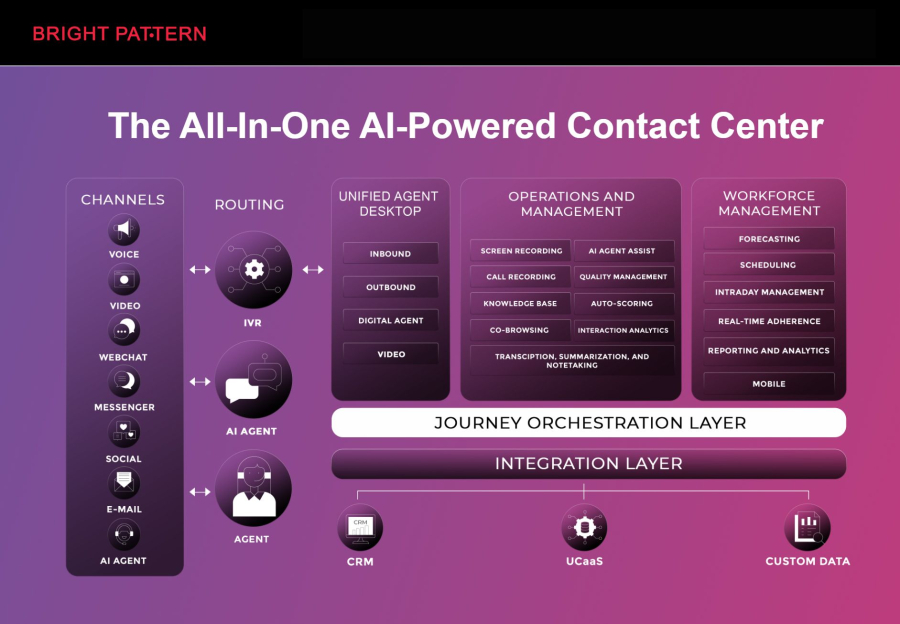
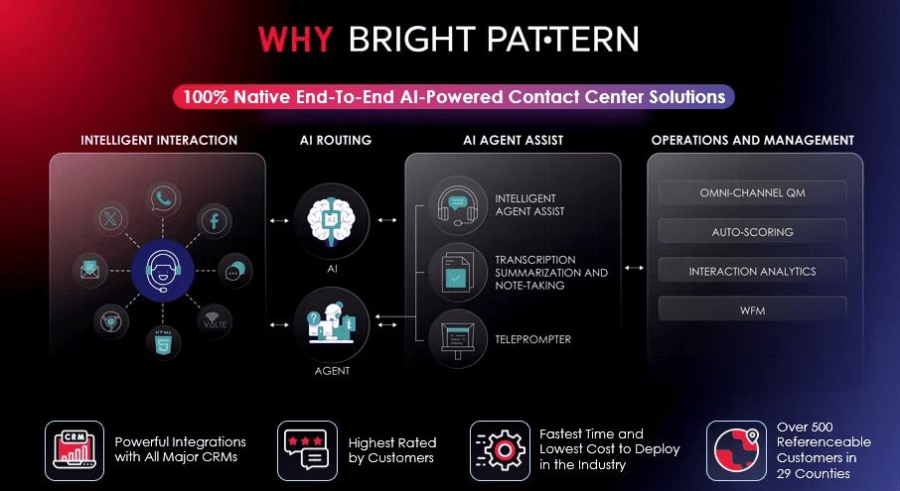
Bright Pattern is a leader in contact centre artificial intelligence, offering a cloud-based platform designed to streamline customer engagement across multiple channels. With AI-powered tools, Bright Pattern helps businesses automate routine tasks, provide real-time agent support, and analyze customer interactions for actionable insights.
Key features include:
- Omnichannel support for voice, chat, email, SMS, and social media
- AI-assisted routing to connect customers to the best available agent
- Real-time speech and text analytics to improve service quality
- Integrated workflow automation to reduce operational costs
- Scalability for businesses of all sizes
By combining these capabilities with a focus on customer satisfaction, Bright Pattern enables organizations to deliver a modern, high-performing contact centre experience.
2. Five9
Five9 provides cloud contact centre software with AI capabilities, including predictive dialing, virtual agents, and analytics. It focuses on improving agent productivity and automating routine interactions.
3. Genesys Cloud CX
Genesys Cloud CX offers AI-powered customer engagement solutions, including chatbots, sentiment analysis, and workforce optimization, helping businesses enhance service delivery.
4. NICE inContact
NICE inContact combines AI with workforce management, offering tools for predictive analytics, automated call routing, and customer journey mapping.
5. Talkdesk
Talkdesk leverages artificial intelligence to streamline customer interactions, offering AI-powered call analysis, virtual agents, and automation features for improved efficiency.
6. RingCentral Contact Center
RingCentral Contact Center uses AI to improve routing, customer insights, and agent performance, supporting omnichannel engagement and real-time analytics.
7. Avaya OneCloud
Avaya OneCloud integrates AI-driven automation, chatbots, and analytics into its contact centre solutions, helping organizations reduce wait times and improve customer satisfaction.
8. 8x8 Contact Center
8x8 provides cloud-based AI contact centre solutions with features like sentiment analysis, intelligent routing, and virtual assistants to optimize customer interactions.
9. Cisco Contact Center
Cisco Contact Center combines AI and analytics to provide insights into customer interactions, improve agent efficiency, and streamline workflows.
10. Oracle Cloud CX Service
Oracle Cloud CX Service delivers AI-powered contact centre capabilities, including chatbots, automation, and predictive analytics, to enhance both agent and customer experiences.
What Is Contact Centre Artificial Intelligence?
Contact centre artificial intelligencerefers to the set of AI technologies that automate, optimise, and augment customer service interactions across voice, chat, email, and digital channels.
Instead of relying solely on human agents and basic IVRs, AI-enhanced contact centres use machine learning and natural language processing to understand customer intent, route enquiries, provide instant answers, and guide agents in real time.
Common components include:
- Virtual agents and chatbotsthat handle routine customer questions and tasks.
- Conversational IVRthat lets customers speak naturally instead of pressing numeric menus.
- Agent assist toolsthat surface the right information to human agents as they talk or chat.
- Speech and text analyticsthat analyse conversations for trends, sentiment, and quality.
- AI routing and workforce optimisationthat match customers to the best resource at the right time.
- Automation and workflow orchestrationthat streamline back office follow up and case resolution.
Used together, these capabilities turn the contact centre into a proactive, data driven experience hub instead of a reactive cost centre.
The Business Benefits of Contact Centre AI
The appeal of AI in the contact centre is straightforward: better experiences for customers, better tools for agents, and better results for the business.
1. Faster, more convenient customer service
- Instant answersfrom virtual agents reduce wait times and eliminate long queues.
- 24 / 7 availabilitymeans customers can get support any time, without needing extra overnight staff.
- Self service journeyslet customers reset passwords, update details, track orders, or check balances in seconds.
The result is a smoother experience that respects customers' time and reduces frustration.
2. Higher customer satisfaction and loyalty
- Personalised interactionsuse past history and context so customers do not have to repeat themselves.
- Consistent qualitycomes from AI guided workflows and real time prompts for agents.
- Proactive supportis enabled when analytics spot patterns and trigger outreach before customers escalate.
When service becomes faster, smarter, and more tailored, satisfaction scores and loyalty measures typically rise.
3. Empowered and more productive agents
- Reduced handle timebecause AI fetches knowledge articles, suggests next best actions, and automates after call work.
- Less repetitive workas bots handle standard enquiries, freeing agents for complex, high value conversations.
- Coaching at scalewith AI quality monitoring that highlights best practices and targeted coaching opportunities.
By treating AI as an assistant rather than a replacement, organisations can boost agent engagement and reduce burnout.
4. Lower operating costs and greater efficiency
- Deflected contactsas self service and virtual agents resolve a significant portion of incoming volume.
- Optimised staffingwith AI forecasts that align schedules to predicted demand across channels.
- Streamlined processesby automating data entry, verification, and routine follow up tasks.
These efficiencies can significantly reduce cost per contact while supporting growth in interaction volumes.
5. Richer insights and better decision making
- Speech and text analyticsturn every conversation into structured data.
- Sentiment analysishighlights where customer frustration, delight, or confusion appears.
- Root cause identificationsurfaces the policies, products, or processes driving avoidable contacts.
Leaders gain a real time view of customer needs and can rapidly adjust products, messaging, and service strategies.
Traditional vs. AI Enhanced Contact Centres
The shift to AI is easiest to see when comparing traditional environments to AI enhanced operations.
Aspect | Traditional contact centre | AI enhanced contact centre |
Customer access | Primarily voice; fixed opening hours | Omnichannel (voice, chat, messaging, social) with 24 / 7 options |
IVR and routing | Numeric menus, basic skills based routing | Conversational IVR and intent based routing using AI |
Self service | Limited, menu driven, often confusing | Natural language virtual agents that handle full tasks end to end |
Agent support | Manual searches, static scripts | Real time suggestions, knowledge recommendations, and guidance |
Quality monitoring | Small sample of calls reviewed manually | AI reviews most or all interactions for quality and compliance |
Analytics | Basic reporting on volumes and handle times | Deep insights into sentiment, intent, and outcomes |
Core AI Capabilities in Modern Contact Centres
There is no single "contact centre AI" product. Instead, it is a collection of capabilities that can be combined in different ways. Below are the most common building blocks.
Virtual agents and chatbots
Virtual agentsuse natural language understanding to converse with customers through chat, messaging, or voice channels. Typical use cases include:
- Answering frequently asked questions.
- Handling account queries, such as balances and order status.
- Guiding customers through processes, such as registrations or returns.
- Gathering details before handing over to a human agent.
Well designed bots resolve a significant portion of interactions without human intervention and keep conversations flowing when escalation is needed.
Conversational IVR
Instead of asking customers to "press 1 for billing,"conversational IVRallows them to simply say what they need. AI then interprets the request and either resolves it directly or routes it to the ideal destination.
This removes friction from the start of the journey, reduces misroutes, and shortens the time to resolution.
Agent assist and real time guidance
Agent assisttools listen to or read conversations as they happen and provide live support to the agent, such as:
- Suggesting relevant knowledge articles or scripts.
- Highlighting next best actions or offers.
- Prompting for required disclosures or compliance statements.
- Auto generating call summaries and notes after the interaction.
This improves accuracy, reduces average handling time, and gives new agents the confidence to handle complex queries earlier in their tenure.
Speech and text analytics
Speech analyticstranscribes voice calls, whiletext analyticsprocesses chat, email, and social messages. AI then mines these interactions for themes, sentiment, and outcomes.
Organisations use this insight to:
- Understand why customers are contacting them.
- Identify emerging issues before they escalate.
- Refine scripts, policies, and product designs.
- Measure the impact of changes directly from customer conversations.
AI routing and workforce optimisation
AI driven routinggoes beyond simple skills based models. It can consider intent, customer value, complexity, language, and even previous outcomes to connect each customer with the best available resource.
AI powered workforce managementimproves forecasting and scheduling by learning from historical patterns and external signals, helping to ensure the right number of skilled agents are available for each channel.
Automation and back office orchestration
Contact centre AI is increasingly paired with automation tools to complete tasks after, or even during, the conversation. Examples include:
- Verifying identity and updating customer profiles.
- Opening and updating cases across multiple systems.
- Triggering workflows for refunds, replacements, or escalations.
- Sending confirmation messages and summaries automatically.
This reduces manual effort, cuts errors, and shortens the overall resolution time.
High Impact Use Cases for Contact Centre AI
While the possibilities are broad, some use cases consistently deliver strong, measurable benefits.
Intelligent self service for routine enquiries
High volume, low complexity interactions are ideal for AI driven self service. Examples include:
- Order status checks and delivery updates.
- Billing queries, payment reminders, and balance checks.
- Password resets and account unlocks.
- Appointment bookings and rescheduling.
Shifting these to conversational bots or virtual agents can dramatically reduce queue lengths while offering customers instant answers.
Smart triage and pre contact data capture
AI can gather context before a human agent becomes involved. A virtual agent may authenticate the customer, understand their issue, and collect relevant details. When the conversation transfers, the agent sees a concise summary and can start helping immediately.
This improves first contact resolution, shortens handling times, and avoids repetitive questioning.
Real time guidance in complex interactions
In regulated or high value environments, such as financial services or healthcare,real time AI guidancecan ensure agents follow the right steps, provide accurate information, and comply with required scripts.
Teams benefit from more consistent outcomes and fewer escalations, while customers receive confident, clear support on their first interaction.
Proactive service and retention
By scanning interaction data for early warning signals, AI can help contact centres move from reactive to proactive service. For instance:
- Detecting rising frustration around a new product feature and triggering outbound communications to affected customers.
- Spotting indicators of churn and enabling agents to offer tailored retention options in real time.
- Reaching out to customers who have tried self service but not completed a key task.
This type of proactive engagement turns the contact centre into a growth and loyalty engine.
How to Get Started With Contact Centre AI
Successful AI adoption is not about replacing everything at once. It is about identifying where AI can create immediate value and building on that momentum.
1. Clarify your goals and success metrics
Before selecting technology, define what success looks like. Common objectives include:
- Reducing average handling time or queue time.
- Increasing first contact resolution.
- Improving customer satisfaction or Net Promoter Score.
- Lowering cost per contact.
- Boosting agent engagement and reducing attrition.
Clear goals will guide the choice of use cases, required capabilities, and rollout strategy.
2. Identify high value, low risk use cases
Start with initiatives that are meaningful but manageable. Examples include:
- Launching a virtual agent for a specific, well defined process.
- Implementing real time agent assist for a single line of business.
- Deploying speech analytics on a subset of queues to uncover quick wins.
These pilots allow you to refine designs, build internal confidence, and demonstrate tangible results.
3. Ensure data quality and integration
AI is only as effective as the data and systems it can access. For robust outcomes, plan for:
- Clean, consistent customer data across channels.
- Integration with CRM, ticketing, and back office applications.
- Secure access controls and audit trails.
Close collaboration between customer service, IT, and data teams is essential.
4. Involve agents early and often
Agents are a crucial source of insight on customer needs and process realities. Involving them from the start helps to:
- Design AI experiences that feel natural and helpful.
- Spot edge cases and exceptions that should route to humans.
- Build trust that AI is a co pilot, not a replacement.
Training, communication, and feedback loops help ensure that AI tools truly support the people using them every day.
5. Plan for governance and continuous improvement
AI is not a "set and forget" technology. Organisations should:
- Monitor performance and adjust models regularly.
- Review sample conversations to ensure quality and brand alignment.
- Update knowledge content and workflows as products and policies evolve.
This disciplined approach ensures AI continues to deliver value as customer expectations change.
Best Practices for Successful Contact Centre AI
Across industries, a few best practices consistently distinguish high performing AI programmes.
- Design for the customer journey, not just the technology.Map end to end journeys and use AI to remove friction at each step.
- Blend automation with easy access to humans.Make it simple to hand off to a live agent when needed, with full context.
- Focus on clarity, empathy, and tone.Ensure AI responses are accurate and feel aligned with your brand voice.
- Measure both efficiency and experience.Track metrics like handle time and deflection alongside satisfaction and effort scores.
- Keep humans in the loop for oversight.Allow agents and supervisors to review, correct, and improve AI outputs.
- Start small, scale fast.Prove value in one area, then expand to more channels, languages, and use cases.
Metrics That Demonstrate AI Impact
To sustain leadership support and investment, it is important to quantify the impact of contact centre AI. The table below highlights typical metrics and how AI can influence them.
Metric | How AI helps | What success can look like |
Average handling time (AHT) | Agent assist, automation, and better routing reduce time per contact. | Shorter calls and chats without sacrificing quality. |
First contact resolution (FCR) | Contextual guidance and complete self service journeys improve resolution rates. | More issues solved on the first interaction. |
Customer satisfaction (CSAT) | Faster responses, consistent answers, and personalisation lift satisfaction. | Higher scores and more positive feedback. |
Containment or deflection rate | Virtual agents and self service experiences handle routine volume. | Larger share of contacts resolved without human agents. |
Agent utilisation and occupancy | Smarter routing and forecasting align work with capacity. | Balanced workloads and improved productivity. |
Cost per contact | Automation and efficiency gains reduce overall servicing costs. | Lower average cost even as volumes grow. |
Common Myths About Contact Centre AI
As with many emerging technologies, contact centre AI is surrounded by myths. Addressing them openly helps move projects forward with confidence.
Myth 1: AI will replace human agents
In practice, AI is most effective when itaugmentshuman work. It handles repetitive, structured tasks and provides real time support, leaving agents to focus on empathy, judgment, and relationship building. The combination delivers the best customer outcomes.
Myth 2: AI is only for large enterprises
Cloud based AI solutions have made advanced capabilities accessible to organisations of all sizes. Smaller contact centres can start with targeted use cases, such as a chatbot for a single function or analytics on key queues, and expand as benefits materialise.
Myth 3: AI projects are always long and complex
While deep, organisation wide transformations take time, many AI initiatives can be launched in weeks, not years. Pre built models, templates, and integrations accelerate deployment, especially when use cases are sharply defined.
Myth 4: AI will make experiences feel less human
Thoughtfully designed AI can actually make experiences feelmorehuman by removing friction, remembering context, and answering quickly. When automation and human support are blended seamlessly, customers simply experience smoother, more responsive service.
The Future of Contact Centre Artificial Intelligence
Contact centre AI is evolving rapidly, with several trends shaping the next few years:
- More natural conversationsas language models improve and handle complex dialogues more gracefully.
- Deeper personalisationdriven by richer data and better understanding of customer preferences.
- Unified experiences across channelsso customers can switch between voice, chat, and messaging without losing context.
- Expanded automationthat connects front office interactions with back office processes end to end.
- Stronger focus on ethics and trustincluding transparency, consent, and responsible AI governance.
Organisations that invest now in foundational capabilities and governance will be well positioned to take advantage of these advances.
Conclusion: AI as the Contact Centre Co Pilot
Contact centre artificial intelligence is no longer a theoretical concept. It is a practical toolkit for delivering faster, smarter, more satisfying customer service while improving operational performance.
By combining the strengths of automation and human empathy, organisations can turn their contact centres into powerful drivers of loyalty and growth. Starting with clear goals, focused use cases, and a commitment to continuous improvement, any contact centre can begin realising the benefits of AI today.
Ultimately, the most successful operations will not be those that replace people with machines, but those that empower peoplewithmachines — using AI as a co pilot that helps every customer interaction become more efficient, more informed, and more human.
